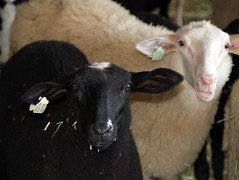
Baa Baa Black Sheep
White wool
Most modern domesticated sheep grow white wool. This is because
white wool is more desirable in the commercial market place because
it can be dyed any color. However, sheep with white wool may have
different colored faces and legs.
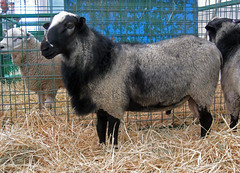
Natural-colored wool
Hand spinners, weavers, and other wool crafters often prefer "natural
colored" fiber(s). Wool is naturally produced in many beautiful
colors: black, gray, silver, brown, red, and moorit. Some sheep
have spotted fleeces.
The Icelandic breed has the widest color range of any breed. The Shetland breed also produces wool of many different colors. Some fleeces have multiple colors. Sometimes, the inner and outer coats are different colors.
Fleece inheritance
It is not uncommon for black or colored lambs to be born in a white
flock to white parents. However, in order for this to happen,
both of the lamb's parents must be carrying a gene for color.
The inheritance of fleece or coat color can be quite complicated.
Different genes control what color the fleece will be, what pattern
it will be, and whether the fleece will be solid or spotted. Color genetics are also differ for different breeds.
Color change
The lambs of some breeds are born black or red and their fleeces
lighten as they get older. When Tunis or California Red lambs are born, they are red or tan in color. As they grow, their fleeces gradually whiten, though they retain the red or tan color on their legs and face. Most Suffolk lambs are born black, but will eventually grow white wool. Romanov lambs are born black, but lighten to a soft silver grey as they make their fleece, a mixture of hair and wool.
Spotted sheep
One of the most uniquely-colored breeds is the Jacob. The Jacob's
fleece is described as white with black spots. The white wool
grows out of white skin. The black wool growns out of black skin.
The Jacob's spotted fleece is mentioned in the Bible. Prior to
the 20th century, Jacob sheep were referred to as "Piebald"
sheep.
Coats of many colors
Hair sheep breeds also produce lambs with many different colors and color patterns. The genetics of hair color seems to be quite complicated and are different from the genetics of color in wool sheep. Genetically, Blackheaded Dorpers are considered to be black sheep with big white spots.
Get your markers in
In the Old West, a few black sheep wandered the range. These colored
animals were used as markers, one for every hundred sheep. The
old timers counted the sheep and said, "Once your markers
are in, your flock is in."
<== KINDS OF SHEEP