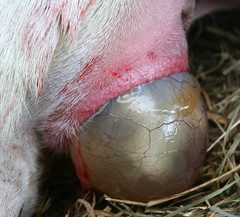
Baby on the way
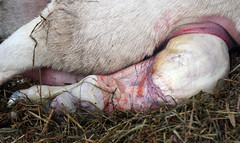
Lamb just born
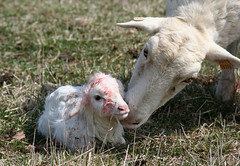
Licking her lamb
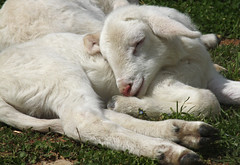
Sleeping baby
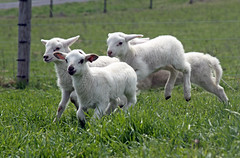
Lambs running
|
Mary had a little lamb . . . or two
A normal delivery
Most ewes give birth to their lambs
without any difficulty or need for assistance from the shepherd or a veterinarian.
Normal presentation is the nose and two front legs, one lamb at
a time. A backwards delivery (hooves pointed down) is also considered normal, though many shepherds will provide assistance if they observe this situation.
Dystocia (difficult births)
Difficulties arise when the lambs are not in the proper position
for delivery or when there are other problems causing a difficult
birth. The most common malpresentation is when one or more of
the lamb's front legs is back. Sometimes, just the elbows may be locked. These are usually simple for the shepherd to correct. One of the most frustrating deliveries to correct is one in which the lamb's head is back. The lamb has to be pushed back to straighten the neck and get the head lined up with the ewe's backbone.
Breech baby
A breech birth is when only the rear or tail of the lamb is presented
for delivery. Even the back legs are tucked under. A ewe cannot
deliver a breech lamb on her own. In fact, she will go into hard labor. Usually, the back legs are brought
forward and the lamb is delivered backwards. Care is taken
to make sure the umbilical cord doesn't cut off the lamb's oxygen
supply before the lamb is out.
Twin or triplet lambs can sometimes get tangled in the womb or
attempt to be born at the same time. Care must be taken to figure
out which parts belong to which lamb and to re-position the lambs
for delivery. Sometimes, a lamb is too big or the ewe's pelvic
area is too small for delivery. In this case, the lamb may have
to be sacrificed to save the life of the ewe.
Ringwomb
Sometimes the ewe's cervix fails to dilate (open up) or dilate sufficiently
for the lamb(s) to be born or delivered. This is a particularly difficult
delivery to assist with and it is possible to lose both the ewe
and her lamb(s). The best course of action is to remove the lambs
via a caesarian section. Unfortunately the cause of "ringworm"
is mostly unknown, though a genetic cause has been postulated.
Various health problems, both infectious and non-infectious, can
affect a ewe's ability to deliver her lambs normally. Poor
breeding decisions, overfeeding or underfeeding, and stress can
all lead to difficult births. There are also several diseases which
can cause a ewe to abort (terminate) her pregnancy or give birth
to weak lambs that die shortly after birth. The infectious organisms
that cause a ewe to abort her lambs may also cause a woman to
miscarry. Consequently, pregnant women should not handle newborn fetuses or placenta.
Quick starters
After a lamb is born, the ewe begins to lick it. Cleaning
and licking is part of the ewe-lamb bonding process. It also helps
to dry the lamb. It is usually not necessary to towel dry newborn lambs. In many cases, the ewe will clean the lambs in
the order in which they are born. She may "talk" to
her lambs as she licks them.
Lambs are usually able to stand within 30 minutes after birth.
Instinct tells them to look for milk. If a lamb is slow to get
up, the ewe will encourage it by nudging or pawing at it. The
lamb usually has its first meal before it is an hour old. An experienced
ewe will try to orient the lamb(s) in the right direction, since
lambs aren't born knowing whether the udder is in the front or
rear of the ewe.
First milk
The first milk that the ewe produces is called colostrum. Colostrum is
very nutritious and contains antibodies that protect the lamb
from infection during the early part of its life. It's important
that a lamb consume adequate colostrum during its first 24 hours
of life, an amount equivalent to 10 percent of its body weight.
Lambs suckle frequently during their first few weeks of life,
from 1 to 2 times per hour, for as long as 3 minutes each time.
But, by the end of their fifth week, they will only be sucking
once every 2 hours.
Baby lambs
Baby lambs are like other baby animals. They sleep a lot, approximately
8 to 12 hours per day. They like to play with other lambs. They
nibble on things. They are very curious of their surroundings.
They get into "trouble." They like to climb on their mothers' backs.
They like to play games like "king of the hill."
They prance around
on all fours when they have room to run. Young lambs like to get into
groups and run back and forth in a field or around the feeder
in a pen. They get tired and take naps. When it's nap time, they
will seek their mother out and sleep as close to her as possible.
Go to previous page=>
<== RAISING SHEEP
|