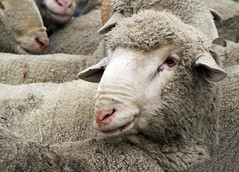
Science of the lambs
Research
Each year approximately 24,000 sheep and lambs are used in research
in the United States (USDA, 2000). Sheep have been used as a model
in heart valve research. Research with sheep led researchers to
perfect and implant the arteriovenous shunt, a device that allows
patients with kidney failure to be connected to dialysis machines
for long term treatment. Sheep have been used in the development
and testing of a device that assists lung function in infants
soon after birth. Sheep have been used as a model to develop techniques
for fetal heart surgery.
Read Raising
Sheep for Science=>
Orthopedics
The use of sheep for orthopaedic research continues to increase.
This is due to sheep's similarity with humans in weight, bone
and joint structure and bone regeneration. Sheep models have been
used to study bone healing and test synthetic bone replacements.
The spina cord of the sheep is similar to the spina cord of humans,
so sheep can be used as models for spinal cord research.
Ovaries
Scientists in Israel successfully transplanted frozen and thawed
ovaries in sheep, retrieved oocytes from the ovaries, and triggered
them in the laboratory into early embryonic development. This
holds out hope that this approach could become a feasible treatment
for women facing premature ovarian failure. The new freezing techniques
may also have potential for other human transplants. Sheep were
chosen for this research because their ovaries are similar.
Source:
Medical News Today
Artificial lung
The MC3 BioLung® (artificial lung technology) is a device
designed to suppor the respiratory needs of adult patients as
a bridge to lung transplantation or lung recovery. The technology
is being tested in adult sheep.
Osteoporosis
Osteoporosis sufferers could soon have sheep to thank for new
types of therapy. Scientists have demonstrated how even gentle,
but regular shaking of the limbs can ward off the weakening of
the bones associated with the disease. The researchers showed
this by mechanically stimulating the hind legs of adult sheep
for 20 minutes every day for a year by standing them on a vibrating
platform. By the end of the study, the density of spongy bone
in the animals' thighs was 34 percent higher than in sheep not
receiving the treatment.
Source:
BBC News
Osteoporosis reduces the density and quality of bone, leading
to weakness of the skeleton and an increased risk of fracture.
The bones most at risk are the vertabrae, wrist, hip, and pelvis.
Approximately 1 in 9 people suffer from osteoporosis or low bone
mass.
Huntington's disease
A nervous system disorder in sheep might someday help people who suffer from Huntington's disease. Some sheep are carriers for GM1 gangliosidosis, an inherited disease that progressively destroys nerve cells in the brain and spinal cord. GM1 gangliosidosis is a therapy for Huntington's disease, Parkinson's disease, spinal cord injury, and strokes. GM1 can be extracted from the tissues of slaughtered lambs that are infected with the disease. Currently, funding is being sought for clinical trials.
Huntington’s disease is a hereditary, degenerative disease that diminishes the ability of those who have it to walk, talk and reason. There is no cure for it.
Source: Aberdeen News, December 23, 2014
Tay-Sachs disease
Research has revealed that Tay-Sachs disease exists in some flocks of Jacob sheep. Jacobs are a rare breed of small, piebald, multi-horned sheep. Tay-Sachs is a deadly disease of the nervous system passed down through families. Jacob sheep are being used as a model to study Tay-Sachs disease and develop gene therapies that may one day provide a cure for the deadly disease.
Source: American Livestock Breeds Conservancy
Learn about transgenic sheep=>
Find out what they do with sheep's
blood=>
<== SHEEP PRODUCTS