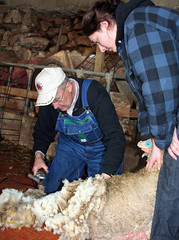
 Teaching sheep shearing
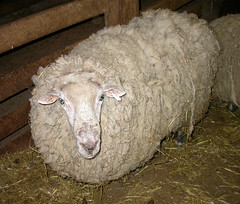
Overdue for shearing
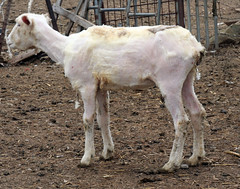
Freshly shorn sheep
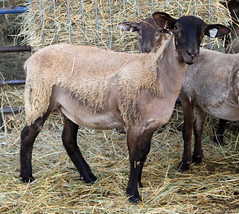
Hair x wool cross
|
You need a hair cut
Shearing
Cutting or shaving the wool off of a sheep is called shearing.
Shearing doesn't usually hurt a sheep. It's just like getting a hair cut.
However, shearing requires skill so that the sheep is shorn efficiently
and quickly without causing cuts or injury to the sheep or shearer.
Most sheep are sheared with electric shears or shearing machines.
The fleece is removed in one piece.
Some sheep are sheared manually with scissors or hand blades.
While some farmers shear their own sheep, many hire professional
sheep shearers. In many countries, including the United States,
there is a growing shortage of qualified sheep shearers. Many
states hold annual sheep shearing schools.
A professional shearer can shear a sheep in less than 2 minutes. The world record is 37.9 seconds. The record was set in 2016 by Ivan Scott from Ireland. Scott set another record, shearing 867 lambs in just 9 hours. Matt Smith from New Zealand owns the record for shearing the most ewes, 731 ewes in 9 hours. The most Merino ewes sheared in 8 hours is 497, a record set by Lou Brown from New Zealand. The blade shearing record was set over 100 years ago when legendary shearer Jackie Howe sheared 321 sheep in 7 hours and 40 minutes.
View You
Tube video of sheep shearing=>
Sheep are usually sheared once per year, usually before lambing
or in the spring before the onset of warm weather. Sheep with
long fleeces are sometimes sheared twice a year. Feeder lambs
are sometimes sheared to make them more comfortable during the
summer. Shearing prior to lambing results in a cleaner environment
for baby lambs. It also keeps the fleeces cleaner.
Skirting
High quality fleeces are often skirted. Skirting is when the undesirable
parts of the fleece are removed from the rest of the fleece. Undesirable parts
include bellies, top knots, and tags. A tag is a piece of wool with manure attached to it. While less valuable, the less desirable parts of the fleece still have uses. For example, a company in Utah is using belly wool to make wool fertilizer pellets.
New technologies
Because sheep shearing is so labor-intensive, other technologies
are often being explored for more efficient wool removal. Australian
scientists created a chemical method of shearing called "bio-clip."
With bio-clip, the sheep were injected with a natural protein that
caused the wool follicle to break and the fleece to drop off on
its own. This technology has never really caught on.
Scientists have developed a shearing table so the shearer doesn't
have to hold the sheep. They have also developed a "robot"
for shearing.
Freshly shorn sheep
Freshly shorn sheep need protection from the elements. It takes
up to six weeks for the fleece to regrow sufficiently to provide
effective insulation. Sheared sheep also require more feed to
maintain their body temperatures, especially during the winter. Sheep should not be sheared in the winter, if protection (usually housing) is not available.
Continuous growth
Sheep grow wool continuously. If they are not sheared at least
once a year, they become very stressed and uncomfortable, especially
when it is hot and humid. Eventually, the wool will become matted, stained, and difficult to remove. It is inhumane to not shear sheep that require it. Sheep owners who don't want to shear their sheep should opt for hair sheep.
Hair sheep
Hair sheep do not require shearing because they lack sufficient
woolly fibers or because their coats naturally shed. However, crosses
between hair sheep and wooled breeds usually need to be sheared. Their
fleeces are not desirable because they contain a mixture of hair
and wool fibers. They should not be mixed with wool because they will degrade the value of the wool. It takes anywhere
from 1 to 3 generations of crossing to eliminate the need for
shearing of the crossbred progeny.
<== RAISING SHEEP
|